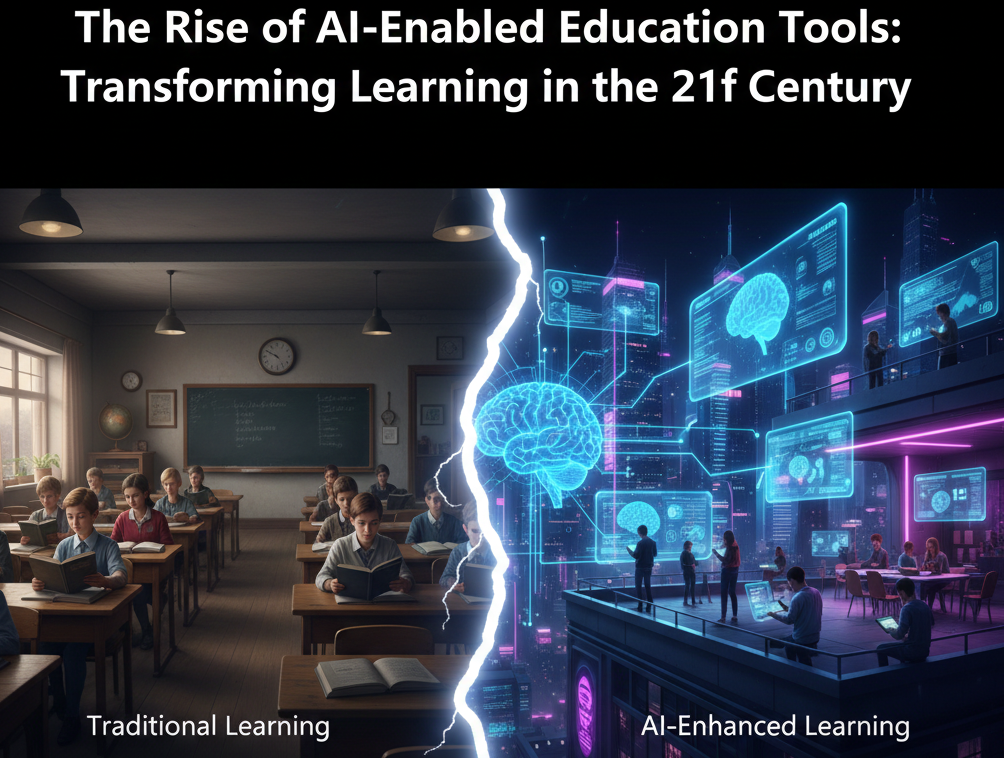
Education has always been about more than textbooks and lectures — it’s about understanding, creativity, and personal growth. But the last decade has brought a new player to the classroom: Artificial Intelligence (AI). From personalized tutoring to intelligent grading systems, AI-enabled education tools are reshaping how students learn, how teachers teach, and how institutions operate.
The rise of these tools isn’t just a technological trend; it’s a cultural shift in how we view knowledge and learning itself.
Personalized Learning at Scale
One of the most exciting impacts of AI in education is personalization. Traditional classrooms often rely on a “one-size-fits-all” approach, which can leave some students behind and others unchallenged.
AI-powered platforms can now:
- Assess a student’s strengths and weaknesses in real time.
- Recommend exercises, lessons, or resources tailored to individual learning styles.
- Adjust difficulty levels automatically to keep students challenged but not overwhelmed.
The result is a learning experience that feels more like a personal tutor than a generic curriculum.
Efficiency for Teachers
AI doesn’t just benefit students — it’s a game-changer for educators as well. Administrative tasks like grading, attendance tracking, and assignment feedback can be automated, freeing teachers to focus on creative instruction and mentorship.
Some AI systems can even analyze patterns in student performance across classes, helping educators identify struggling students early and provide targeted support. This is a level of insight that would be impossible without intelligent tools.
Interactive and Immersive Learning
AI is also making education more interactive and engaging. Tools like virtual tutors, adaptive quizzes, and AI-driven simulations allow students to experiment, make mistakes, and learn in a safe, feedback-rich environment.
Emerging technologies such as AI-powered VR/AR experiences are bringing history, science, and complex concepts to life in ways that were unimaginable just a few years ago. For example, medical students can practice surgeries virtually before entering a real operating room, and physics students can manipulate virtual molecules to see principles in action.
Challenges and Ethical Considerations
Despite the promise, AI in education raises important questions.
- Equity and access: High-tech tools may widen the gap between schools with resources and those without.
- Data privacy: AI platforms collect sensitive information about student performance and behavior, which must be carefully safeguarded.
- Human connection: While AI can personalize learning, it cannot replace the mentorship, empathy, and inspiration of a human teacher.
Balancing innovation with ethics is critical to ensure AI enhances education rather than undermines it.
AI and Lifelong Learning
The impact of AI extends beyond K–12 and universities. In a rapidly changing job market, adults are increasingly turning to AI-enabled platforms for reskilling and professional development. Personalized learning paths, AI tutors, and smart recommendations allow workers to acquire new skills efficiently, keeping them relevant in evolving industries.
The Future of Education
AI-enabled tools are ushering in a new era of learner-centered education, where technology supports, rather than replaces, human potential. The most effective educational systems in 2026 and beyond will combine the precision of AI with the creativity, mentorship, and compassion of educators.
As AI continues to evolve, students may no longer be limited by time, location, or standardized curricula. Instead, education will be more adaptive, engaging, and inclusive than ever before — empowering learners to reach their full potential in ways we are only beginning to imagine.